Avangrid
Redesigning how customers start, stop, and transfer utility service
Avangrid serves millions of utility customers across the Northeast. Starting, stopping, or transferring service should have been routine, but the existing experience pushed most customers to the phone and left many unsure their request had gone through.
I led research and end-to-end product design for the move-in / move-out experience, working with customers and Avangrid’s CX, product, operations, and engineering teams to turn a call-center-heavy process into a digital journey customers could trust.
Role
Principal Designer / Research Lead
Timeline
2021 - 2022
Platform
Responsive Web
Service Design
UX Research
Product Strategy
Concept Testing

At a glance
A digital option already existed.
Most customers still picked up the phone.
Situation
80% of customers called to start, stop, or transfer their service, despite an online option
The contact center was the most used channel for starting service and the one with the lowest satisfaction. 30% of customers needed more than one contact to activate service, and 44% spent more than ten minutes setting up and confirming a start date.
Approach
Understand the entire start/stop service process, not just the customer-facing screens
I led foundational research with current customers, mapped what happened inside Avangrid after each request, ran a cross-functional strategy workshop, then designed and tested two competing concepts before setting the final direction.
Outcomes
The first win of many in a digital transformation across multiple key customer touchpoints
01
Spearheaded the shift to digital and self-service
The redesigned journey became part of Avangrid’s broader CX transformation, which shifted 80% of customer interactions to digital channels.
02
200% NPS improvement
The move-in / move-out redesign contributed to a 200% increase in NPS across customer journey channels.
03
A transformation template for future customer touchpoints
The move in / move out transformation established the experience framework and design patterns later extended to other customer journeys like outages, billing, and account, and the program went on to win an E Source award in 2024.


Challenge
Make the digital option the one customers trust. Even in the middle of a move.
Approach
This was a service design problem: research the customer touchpoints and what's behind the curtain, reframe the journey, then test competing ideas.
Examples
Three moments that shaped the final design
01: Behind the curtain
Mapping the system behind the customer journey
We mapped six current-state journeys (start, stop, and transfer, across both the website and the call center) in layers: customer actions, internal activities and systems, pain points, and opportunities.
The maps exposed problems customers could feel but not see. Web requests still needed manual processing. Identity verification depended on manual steps. Address data wasn’t fully synced with USPS records, confirmations were inconsistent, and service blocks appeared without an explanation or a clear path forward.
A line from Avangrid leadership in our strategy workshop became a guiding principle for the rest of the project:
“I don’t want to create a pretty interface that has messed up processes behind it.”
Process maps I created for starting, stopping and transfer service requests

02: Designing for confidence
Customers didn’t just want convenience. They wanted confidence.
Channel adoption first seemed like a usability problem, but interviews with customers who recently started, transferred, or stopped service told a more nuanced story: reassurance mattered as much as speed, and the stress that people experience when moving can amplify small uncertainties.
Three behavioral archetypes emerged based on our research with customers. These archetypes not only helped the team design for different attitudes instead of forcing everyone into one channel, but they were also circulated across the organization to generate awareness and customer empathy.
Response
Design reassurance into every step
Set expectations before asking for effort: what customers need and how long it will take. Confirm immediately, then make status and next steps easy to find later, while keeping support available for customers who need it.


03: Testing two directions
Two concepts, one stronger final direction
Rather than refine one solution too early, we designed two distinct concepts for starting service. One concept was a linear flow with a single question per step. A second concept was a hub approach with grouped questions in collapsible sections, with more visible progress.
We conducted one-on-one sessions with customers, who walked through both concepts in counterbalanced order and then compared them directly. The goal was to understand why each approach worked so we could combine the strongest elements.
Customers preferred the linear, one-question-at-a-time approach but liked several specific pieces of the hub approach. Testing with customers revealed the design was on the right track:
No major blockers
Expected under 10 minutes
Clear expectations reassured
Time estimates built confidence
Photo ID verification delighted
Bill estimates struck a chord
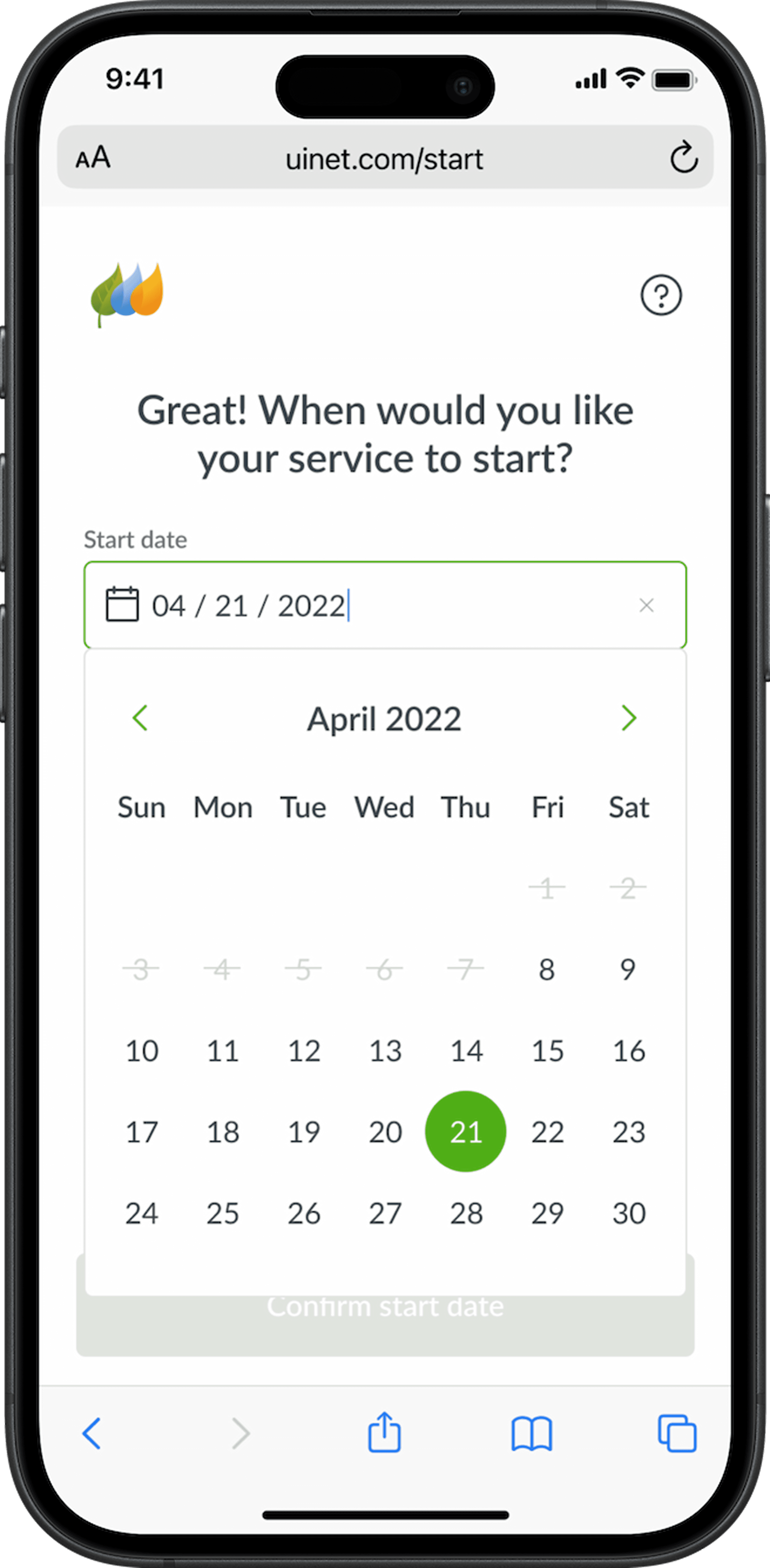
Example keyscreens from the final design that merged the best of both concepts




Impact
Trusted self-service channels, positive customer feedback, and a template for future change.
of customer interactions shifted to digital channels across the broader CX transformation
200% NPS improvement
The redesigned move-in / move-out journey contributed to a 200% increase in NPS.
Award-winning program transformation
The broader customer experience transformation at Avangrid earned industry recognition, including a 2024 E Source award. As the first project spearheading the effort, this work established the patterns and practices behind the transformation.

